Sights in Saint-Emilion — 10 of Our Favourites

Discover and book the top Saint-Emilion sights

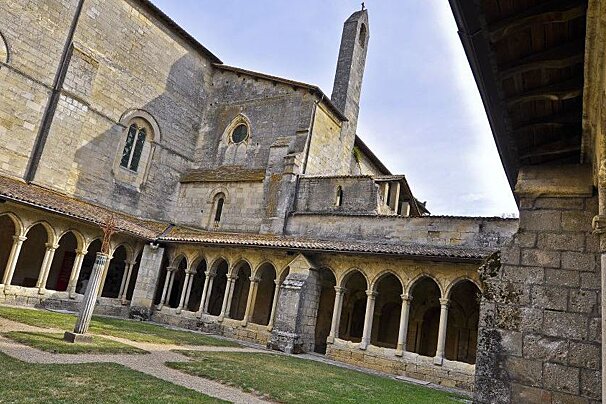
Les Cordeliers Cloister, Saint Emilion

1. Les Cordeliers Cloister, Saint Emilion

Location
Saint-Emilion

The monks originally lived just outside Saint-Emilion, but in 1338 they obtained permission from the Pope to establish a monastery within the walls. The cloister was built in the 14th-century.

For four centuries until the onset of the Revolution in 1789 the Cordeliers (the monks) occupied this site with their church, an entrance courtyard, a winery, a vat room, a cellar, a garden and a dormitory building with six bedrooms. In the late 19th-century the new owners decided to convert the extensive underground spaces into wineries and bottle cellars.

Now listed as a UNESCO World Heritage site and French Historical Monument, the Cordeliers cloister is a perfectly preserved example of late Romanesque architecture.

Clocher de l'Eglise Monolithe Church Tower, Saint Emilion

2. Clocher de l'Eglise Monolithe Church Tower, Saint Emilion

Location
Saint-Emilion

At 68 metres above the ground, looking down on the rooftops of the medieval town, take a deep breath and enjoy the 360° panoramic view of the most famous wine appellation.

The key is available from the tourist office, so entry to the bell tower of the beautiful Monolithic Church, is during tourist office opening hours.

Les Grandes Murailles (The Great Wall), Saint Emilion

3. Les Grandes Murailles (The Great Wall), Saint Emilion

Location
Saint-Emilion

The great wall, or Grandes Murailles, is now all that remains of a once Dominican monastery that was built in the 12th-century.

By tradition, the Dominicans are part of the family of 'mendicant' monks - which means that they relied chiefly or exclusively on charitable donations and begging to survive. Architecturally, certain rules had to be applied to a Dominican monastery, one being that buildings and the church should not exceed a certain height. This section of wall suggests that Saint-Emilion mendicant monks were perhaps not be as poor as their order demanded!

Tension between the French and the English during the Hundred Years War in this region meant that building was ultimately destroyed. At the beginning of the Hundred Years War, French troops who were fighting to reassert the power of their king, took refuge in the monastery. It became a refuge, an observation point and a defensive position. The Dominicans who no longer felt safe there left their large monastery and settled within the walls of Saint-Emilion town. The monastery, meanwhile, was deliberately destroyed, leaving just this stylish piece of wall.

Les Tertres (steep streets), Saint Emilion

4. Les Tertres (steep streets), Saint Emilion

Location
Saint-Emilion

A 'tertre' is a hillock or mound of earth and Saint Emilion has successfully adapted itself by shaping the town around its 'tertres'.

Each one - there are four - is a narrow and steep cobbled street with uneven paving that links various parts of the town together - the upper and the lower city. A rich part of the history of Saint Emilion these cobbles have travelled a long way, originating in fact in England.

After the marriage of Eleanor of Aquitaine and Henry II of England in 1152, the region became English and remained so until the end of the Hundred Years's War in 1453. For three centuries the English ruled this area and traded freely along the Dordogne. The English used small cobble stones to ballast their boats on their journey to France and along the Gironde into the Dordogne river. Once they arrived in Aquitaine, the stones were discarded and replaced by wine barrels.

These stones were then used to created the cobbled 'tertres' of Saint Emilion!

Eglise Monolithe, Saint-Emilion

5. Eglise Monolithe Church, Saint-Emilion

Location
Saint-Emilion

This church, sited in the higher part of Saint-Emilion town, is incredible underground feat, carved out of the rock over three centuries.

As large as a cathedral, it was built by Benedictine monks between the 11th and 12th centuries, and is the largest of its kind in Europe. It has a maze of tunnels that include vast catacombs. The bell tower sits an amazing 53m above the town and offers fantastic views over the area...if you have the energy to climb the 196 steps!

You can take a tour of the underground part of the church where you will discover much more about the heritage of Saint Emilion and the story of the monk Emilion who first settled there in the 8th century. There are some beautiful carvings and murals in the Trinity Chapel. Well worth a visit.

religious building with grass in midle

6. Eglise Collegiale et le Cloitre, Saint Emilion

Location
Saint-Emilion

Built between the 12th & 15th centuries, this church is one of the largest in Gironde. It's design is both Romanesque and Gothic, showing how it has been remodelled and renovated throughout history.

Various exhibitions and events are hosted here, in a place where Augustinian canons once stayed, safe in this monastery until the end of the French Revolution

Access to the cloister area is through the collegiate church which was founded in the 12th century, or through a small door next to the entrance to the tourist office. The church was built canons who were in charge of bringing religious discipline and rigor to the lives of the people of Saint-Emilion.

the exterior of a house in saint emilion

7. La Maison de la Cadene House, Saint Emilion

Location
Saint-Emilion

Although the timber facade of this house in Saint Emilion dates from the 16th-century, the foundations were built even earlier than that.

The gate and doorway itself was probably used to separate the nobility in the upper part of the town from the more modest lower town. The origin of the word "cadena" is from Gascon (a dialect of Occitan) meaning "chain", which could refer to the presence of a chain that physically divided the city into two parts but there is no visible trace on the building today.

The house is the only half-timbered house int he city that has remained intact and still has a remarkable tower on the other side. If you go inside you will be able to see the beautiful corkscrew staircase that dates from the16th-century and allows access to the tower.

The Porte de la Cadène opens the Rue de la Cadène, a pretty little shopping street in Saint Emlion.

looking over the restaurants in place du marche st emilion

8. Place du Marche, Saint Emilion

Location
Saint-Emilion

This square sits in the heart of saint Emilion and is home to the old market hall as well as the entrance to the Eglise Monolithe.

During the busy summer months the centre of this square has outdoor seating and shade for the surrounding restaurants and cafes. The hustle and bustle of the square can be enjoyed from a calm and relaxing table right in the heart of the town.

exterior wall of a ruined palace in st emilion

9. Cardinal Palace ruins, Saint Emilion

Location
Saint-Emilion

Gifted to Gaillard de la Mothe by his uncle Bertrand de Goth, Archbishop of Bordeaux, who later became Pope Clement V, the Cardinal Palace sits at the entrance to the city of Saint Emilion.

The ruins of the 12th-century building are still clearly visible today and it is easy to see the artistic Roman influences in the arches and floral decorations. If you descend into the moat area that runs in front of the walls then you can clearly see that there are some pipes coming out of the wall that would once have been used for elimination of the latrines. This details tells us that this was not built first and foremost as a defensive structure, but rather as a display of wealth and of comfort.

The walls of the palace form part of the old wall that was built along this part of city. Access to this part of the outer walls, outside of the city itself it free, so make sure you take time to explore this.

view over some roofs to La Tour du Chateau du Roi, Saint Emilion

10. La Tour du Chateau du Roi Tower, Saint Emilion

Location
Saint-Emilion

Sited to the west of Saint-Emilion, the impressive square stone keep of this grand King's castle is all that now remains. The views of the city from the tower are well worth the 118 steps.

The castle dates back to the 13th century and was an important city defence. The only Romanesque keep still intact in the Gironde, it rests on a rocky massif isolated from all sides and dug in natural caves and quarries exploited since the Middle Ages. From the floor to the lower terrace at the top, there are 32m.

It was probably promoted by Henry III Plantagenet, King of England and Duke of Aquitaine, in 1237, when Saint Emilion fell again under English control.

The tower is an important site for the 'Jurade', a local organisation that is responsible for ensuring the quality of the Saint Emilion wines and promoting them around the world. They celebrate the Saint-Emilion wines twice a year with town parades which finish at the top. There are great views over the town and the surrounding vineyards.