Golf du Medoc Golf Courses, Le Pian Medoc
Created in 1989, the Golf du Médoc offers 2 remarkable 18-hole courses: Les Châteaux and Les Vignes.

© Clos de la Barbanne
Midway between Bordeaux and Bergerac
Elegant Bordeaux-style mansion nestled in natural manicured gardens where privacy and serenity abound. The Clos de la Barbanne is surrounded by its own exclusive vineyard, located in the heart of the prestigious Saint-Emilion wine region.
The hotel features a private garden with terrace, an indoor swimming pool and an infrared sauna. The rooms are spacious, elegant and tastefully decorated in soft, neutral colours.
A delicious homemade breakfast is served in the dining room or in the garden, to the soothing of the birds in the shade of the linden and maple trees.
Created in 1989, the Golf du Médoc offers 2 remarkable 18-hole courses: Les Châteaux and Les Vignes.
The course, whose tree lined fairways are set in natural forests of maritime pines, mimosas, oaks and evergreen strawberry bushes, is hilly on the front nine and flatter over the back nine with several water hazards.
Running from the ferry terminal at Belisaire on the Arcachon Bay side of the peninsula this small train link passengers to the Atlantic Ocean on the west coast.
100% electric and 100% silent, the infamous tuk-tuk comes to Saint Emilion to take you on a tour or the town and the vineyards that surround it.
Come and experience the ancient art of thousands of years... archery!
Since 1983 Vedettes La Bohême welcome you to visit the Cordouan lighthouse or to discover the mouth of the estuary of the Gironde.
Chef Nicolas Masse offers in this restaurant a combination of traditional French cuisine, made with fresh seasonal ingredients from the southwest sourced from local producers, with unusual influences from all around the world. His creations can be paired with a large selection of wines, by the counsel of head sommelier Aurélien Farouil.
This elegant and sophisticated two Michelin star restaurant offers creative dishes designed by chef Cédric Béchade, who plays with colours and textures in his cuisine.
Situated in a gorgeous white stone townhouse built in the classical style of the late 19th century, this restaurant is part of the joint project of Bernard Magrez, owner of various wineries in the Bordeaux area, and Pierre Gagnaire.
Situated in the luxurious surroundings of Le Grand Hotel de Bordeaux, this restaurant offers diners an elegant yet intimate restaurant styled in a palette of mauve and orange with a handcrafted marquetry floor.
This cosy restaurant serves a selection of Lebanese small dishes, mezze, as well as grilled meats cooked over wood fire. The dining room is very warm thanks to a grand 18th-century stone fireplace.
This restaurant has a spacious and light dining area. They serve traditional uncomplicated French dishes.
Situated at the foot of the historical Porte Cailhau, this bar has a list of more than 100 wines. They are focused on international products as well as some lesser-known wines from Bordeaux.
One of the best places to taste wines from the Bordeaux region. Located on the ground floor of the headquarters of the Conseil Interprofessionel du Vin de Bordeaux, the bar's team is very knowledgeable and passionate. They give tasting advice, extensive information on the grapes and suggestions for matching food and wine.
A diverse music programming that showcases some of the best local and national talent in jazz, music of the World, blues and many other expressions.
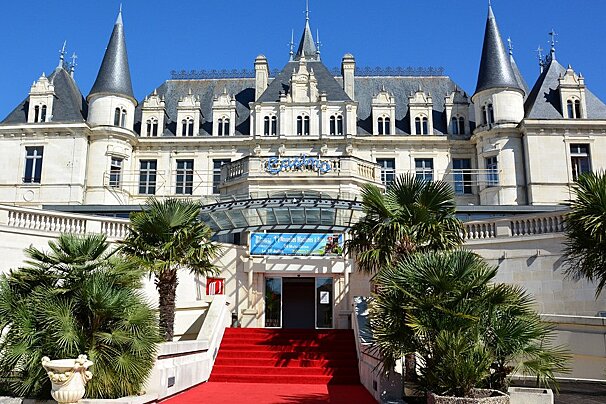
The beautiful building of Chateau Deganne was converted in 1904 into a casino. In the early twentieth century Paris and Bordeaux bourgeoisie came to spend the summer in Arcachon. Thus the town had to create distractions - a casino.
This bar has an old-fashioned decoration that creates a very warm atmosphere. Their wine list includes many French references, as well as from other parts of the world. They can be enjoyed in their cosy interior or the patio, accompanied by selections of local delicatessen.
Centrally located, this bar offers a large selection of wines, especially French but also from other parts of the world. Customers can taste them through a self-service method, and they can be accompanied by regional delicatessen.
A protected natural reserve with wild marshes, sand dunes and pine forests, this huge body of water is perfect for outdoor activities such as sailing, swimming, water skiing, windsurfing, canoeing, fishing, kite surfing, paddle boarding, or walking and biking along the trails and cycle paths that line the shores of the lake.
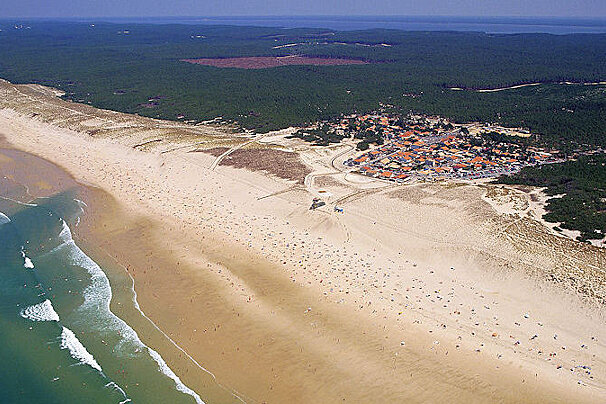
Over time, the wind and ocean currents have gradually created a wall of sand dunes, behind which streams and rivers have allowed the formation of lakes and freshwater ponds.
A small, peaceful and tranquil beach that is situated at the entrance to the marina and is the most sheltered of all the beaches around Arcachon due to its location within the basin.
Backed by the small town of Carcans Océan, this white sand beach on the western Atlantic coast is a popular surf spot.
Le Porge beach is also known for its large waves and strong undertow, even if the rescuers are not far away, you must remain cautious as you would for many of the ocean beaches.
An 800m strip of white sand situated between the Theirs and Eyrac piers this beach is very much in the Arcachon basin and sheltered from the strong Altlantic winds on the coast.
Gifted to Gaillard de la Mothe by his uncle Bertrand de Goth, Archbishop of Bordeaux, who later became Pope Clement V, the Cardinal Palace sits at the entrance to the city of Saint Emilion.
The great wall, or Grandes Murailles, is now all that remains of a once Dominican monastery that was built in the 12th-century.
Although the timber facade of this house in Saint Emilion dates from the 16th-century, the foundations were built even earlier than that.
The monks originally lived just outside Saint-Emilion, but in 1338 they obtained permission from the Pope to establish a monastery within the walls. The cloister was built in the 14th-century.
This square sits in the heart of saint Emilion and is home to the old market hall as well as the entrance to the Eglise Monolithe.
Sited to the west of Saint-Emilion, the impressive square stone keep of this grand King's castle is all that now remains. The views of the city from the tower are well worth the 118 steps.
Vineyards were planted around this old town in Roman times and whilst most people associate the name with the wine, the town itself is worth a visit for its ramparted old centre with interesting Romanesque churches and an incredible underground monolithic church.
You get a sense of this town's history as soon as you arrive, with are flags and coats of arms lining the roads that lead you to the main square.
It has the typical square layout around a central market square that is common with towns of that time and they still hold a market there on Tuesday mornings. It's a good example of a bastide town; these towns were established mainly as commercial centres, encouraged by incentives set down in a charter.
Sainte-Foy-la-Grande sits on the south bank of the Dordogne river. This attractive walled bastide town still has some of its medieval houses and is a good base for visiting the surrounding Sainte-Foy-Bordeaux wine region and nearby Château de Montaigne, home of Michel de Montaigne.
This hilly town used to be the second largest in the region during medieval times, and it's home to the oldest town hall in France dating back to the 12th century.
The pretty town of Saint-Macaire is a good base for seeing the area around Langon. It dates back to the 1st century AD and grew as a battlement town in the first half of the last millennium.